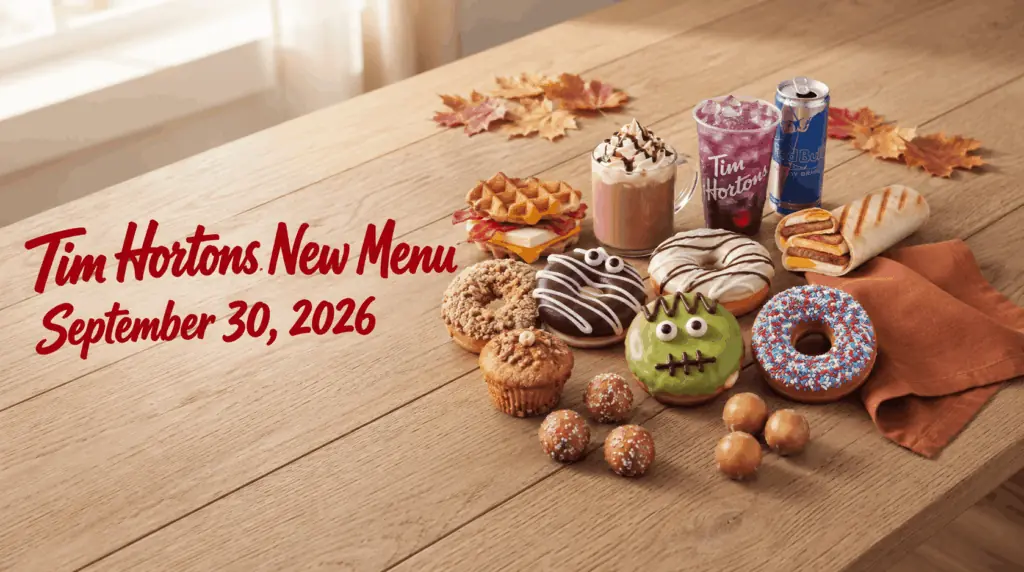
Ask an American what Tim Hortons is known for, and the answer usually starts with coffee and donuts. That’s accurate, but it only tells part of the story. In the United States, Tim Hortons has built its identity around a specific handful of items and habits — brewed coffee, Timbits, the Iced Capp, value-priced breakfast, and a loyalty-driven promotional calendar — that together explain why the chain has a loyal (if regionally concentrated) following outside its Canadian home base.
We put together this guide to answer the question directly: what does Tim Hortons actually mean to U.S. customers, and how does that differ from what the brand represents in Canada? Below, we walk through the core menu items, the ordering culture that surrounds them, and the current state of Tim Hortons’ U.S. footprint.

The Short Answer
If you only have a minute, here’s what defines Tim Hortons for U.S. customers:
Each of these is worth its own explanation, because the “why” behind them is where the real value is for U.S. customers deciding whether — and how — to order.
Coffee and the “Double Double” Culture
Coffee is the anchor of the Tim Hortons menu in both countries, built around the brand’s Original Blend and Dark Roast brewed coffees, along with espresso drinks, lattes, and cold brew. In the U.S., customers can order it the same way they would at most quick-service coffee counters — by cup size and preferred additions.
What trips up some first-time American customers is the ordering shorthand that Canadians use constantly: a “double double” (two creams, two sugars) or a “triple triple” (three of each). This phrasing grew out of Tim Hortons’ Canadian store culture and became so embedded that it was added to the Oxford Canadian Dictionary. It still works at U.S. locations — staff generally understand it — but it isn’t printed on the menu board, and it’s less a rule than a piece of brand trivia that longtime fans like to bring up. For us, that’s part of what makes Tim Hortons distinct from Starbucks or Dunkin’: the coffee itself is straightforward, but the vocabulary around it carries the brand’s Canadian roots into an American store.
Timbits: The Signature Snack
Timbits are Tim Hortons’ name for donut holes, sold individually or by the box in a rotating mix of classic and seasonal flavors. They’re one of the most consistently requested items across U.S. locations and function as the chain’s answer to a shareable, low-commitment treat — useful for an office box order or a quick single-serving snack alongside coffee. Because Timbits are cheap, familiar, and easy to customize by flavor mix, they tend to be the item new U.S. customers are pointed toward first, and they remain one of the clearest markers of “this is a Tim Hortons order” regardless of which side of the border you’re on.
The Iced Capp: Tim Hortons’ Answer to a Frozen Coffee Drink
The Iced Capp is arguably Tim Hortons’ most distinctive beverage. It isn’t iced coffee in the traditional sense — it’s a blended, semi-frozen coffee drink with a texture closer to a coffee slushie than a chilled Americano, typically finished with a swirl of whipped topping on select versions. U.S. locations carry the Iced Capp lineup, including seasonal and limited-time flavor variations that rotate throughout the year.

We think this is worth calling out specifically because the Iced Capp doesn’t have a true one-to-one match at Starbucks or Dunkin’. A Frappuccino or Frozen Coffee is closer in concept than a plain iced coffee, but the texture and sweetness profile are different enough that regular customers tend to order it by name rather than trying to describe it to a first-timer.
Value Breakfast: The 1, 2, 3 Menu
Breakfast is where Tim Hortons has leaned hardest into value positioning in the U.S. market. The current 1, 2, 3 Menu lets guests buy any beverage at regular price and add a classic or specialty donut for $1, a bagel with cream cheese for $2, or an eligible breakfast sandwich for $3. This kind of bundled, beverage-anchored value offer is a direct response to how price-sensitive the U.S. quick-service breakfast category has become, and it’s a large part of why Tim Hortons gets compared to McDonald’s and Dunkin’ on value rather than just on coffee quality.
Beyond the value menu, the broader U.S. breakfast lineup includes breakfast sandwiches, wraps, bagels, and baked goods, with the overall selection generally more streamlined than what’s available on the Canadian menu. That’s a distinction worth repeating: the U.S. menu is not a mirror of Canada’s. It’s a narrower, U.S.-tailored version focused on the items that perform best with American customers.
What’s New on the U.S. Menu in 2026
Tim Hortons U.S. has used 2026 to push further into categories outside its traditional coffee-and-donuts identity. Confirmed additions this year include Protein Lattes (launched in late January 2026), available hot or iced in Classic, Vanilla, Caramel, Mocha, and Sugar-Free Vanilla flavors, positioned as a higher-protein alternative to a standard latte. The brand has also continued building out its TimsBoost energy beverage line and fruit-based Refreshers, alongside seasonal baked goods and specialty drinks tied to limited-time campaigns.
We’d frame this as Tim Hortons trying to compete on more fronts at once — value-conscious breakfast, protein-focused beverages, and energy drinks — rather than resting on the coffee-and-donuts reputation alone. Availability of any limited-time item can vary by location and season, so it’s worth checking current in-store or app promotions before planning a trip around a specific new item.
Roll Up To Win: The Promotion Tim Hortons Is Known For
Few quick-service promotions carry as much brand recognition as Tim Hortons’ Roll Up To Win (originally Roll Up The Rim To Win). Launched in 1986 as a thank-you to customers, the promotion has run for roughly four decades and has evolved from a purely physical “roll up the cup rim” mechanic into a hybrid event that also runs through the Tims App and Tims Rewards program. Recent U.S. runs have paired physical promotional cups with digital rolls earned through app purchases, and prize pools have included everything from vehicles and travel packages to the more common (and far more likely) free coffee, donuts, and Tims Rewards points.

For U.S. customers unfamiliar with it, the practical takeaway is this: Roll Up To Win is typically a late-winter promotion (recent years have run from roughly late February through March), it requires no purchase to enter under the official rules, and the easiest way to participate consistently is through the Tims Rewards program rather than relying on physical cups alone.
Menu Distinctions: U.S. vs. Canada
One of the most common discussions we see among Tim Hortons fans is the difference between the U.S. and Canadian menus. While the core items are similar, there are distinct differences that matter. A Canadian content creator who visited locations in both countries noted that the coffee itself can taste different; the U.S. brew is often perceived as weaker and sweeter . The texture of a chocolate-glazed donut might be denser in the U.S. compared to Canada’s .
Here’s a look at some of the key differences and similarities we’ve observed:
| Category | Tim Hortons U.S. | Tim Hortons Canada | Notes |
|---|---|---|---|
| Coffee Flavor | Perceived as weaker, slightly sweeter | Perceived as stronger, less sweet | Based on customer comparisons |
| Boston Cream Donut | Darker chocolate glaze | Lighter chocolate glaze | Canadian version reportedly has more cream |
| Donut Texture | Denser chocolate glazed | Softer chocolate glazed | Feedback from side-by-side taste tests |
| Cup Lids | Uses older-style lids | Updated, eco-friendly lids | Canadian company is transitioning its lids |
| Pricing | More expensive (before exchange) | Cheaper than U.S. locations | U.S. prices are higher in absolute terms |
| Menu Items | More aggressively updated with U.S. trends (e.g., Protein Lattes) | Differentiates with Canadian-specific items | U.S. menu is adapting to local tastes and trends |
That gap matters for how we’d frame the brand’s U.S. identity: Tim Hortons isn’t trying to be a nationwide coffee chain on the scale of its competitors yet. It’s a regionally concentrated brand, strongest in the Northeast and Midwest, that’s using value pricing, a handful of signature items, and loyalty promotions to build recognition market by market.
| Category | Tim Hortons Canada | Tim Hortons USA |
|---|---|---|
| Founded | 1964, Hamilton, Ontario | 1984, Tonawanda, New York. |
| Approximate location count | Roughly 4,000+ | Roughly 650–700, per recent industry location data |
| Menu breadth | Broader, more region-specific variety | More streamlined, value-focused selection |
| Cultural role | National institution | Regional favorite, expanding footprint |
Location counts are approximate and change as new U.S. restaurants open; treat the U.S. figure as a general current snapshot rather than an exact real-time total.
Where to Find Tim Hortons in the U.S. Right Now
Tim Hortons’ U.S. presence is still concentrated in a limited number of states, though it has been expanding at its fastest pace in over a decade. New York, Michigan, and Ohio currently hold the largest concentrations of restaurants, while newer markets such as Texas, Georgia, Tennessee, Florida, and Maryland have seen recent growth, and additional openings are planned for markets including Washington, D.C., Philadelphia, and San Antonio. Because growth is happening market by market through franchisees, the honest answer for many U.S. readers is that Tim Hortons may not be in your state yet — but the map has been changing quickly enough that it’s worth checking current locations rather than relying on older lists.
Bottom Line
So, what is Tim Hortons known for in the USA? It’s known for being more than just a Canadian coffee chain. It’s a fast, affordable, and rapidly expanding option that provides a reliable core of coffee, donuts, and Timbits, while simultaneously adapting and innovating its menu for American tastes. From protein lattes to seasonal promotions, the chain is actively competing with major U.S. players by focusing on value, speed, and a willingness to experiment. Ready to see everything Tim Hortons has to offer? Explore the Tim Hortons Full Menu to discover the latest coffees, breakfast favorites, donuts, Timbits, cold beverages, and more.
FAQs
All Tim Hortons menu information is researched and maintained by the timhortonsmenu.us editorial team using official Tim Hortons resources. Prices and availability may vary by location.